Visit Overview
The E-Waste World Expo was held on October 28-29 at the Cobb Galleria Centre in Atlanta, Georgia. I visited the exhibition on the morning of October 29.
TSG USA does not currently operate within the recycling industry. Our core business focuses on supporting the development, design, and manufacturing of electronic products. As a result, my purpose for attending was not to evaluate recycling technologies from an industry insider’s perspective, but rather to learn about the current state of the recycling industry from the viewpoint of someone involved in creating electronic products.
Every year, enormous numbers of electronic devices are manufactured around the world. At the same time, an equally large number of products reach the end of their life and are discarded. This reality raises an increasingly important question: how can we effectively recover and reuse the limited resources embedded within these products?
Beyond this personal interest, I was also curious whether there might be areas where TSG USA could contribute in the future, or whether the industry presents potential business opportunities. I attended the event hoping to gain insights into possible intersections between electronics manufacturing and recycling, and perhaps identify opportunities for future collaboration.
What Was Exhibited
The exhibitors represented a broad cross-section of the e-waste recycling ecosystem, including companies specializing in:
- PCB recycling
- Lithium-ion battery recycling
- Shredding and crushing equipment
- Metal and plastic sorting technologies
- Material analysis and elemental testing services
- Recycling plant and processing equipment
- Data destruction services
- Solar panel recycling
- Rare metal recovery technologies
Although I am not a recycling industry expert, one pattern I noticed among many exhibits was the emphasis on shredding or crushing recovered electronic products, followed by processes designed to separate and recover valuable materials.
Atmosphere of the Event
Compared to many technology trade shows, the exhibition was relatively modest in scale. The number of attendees appeared moderate, and the venue maintained a calm and relaxed atmosphere throughout my visit. Since I attended on the morning of the second day, this may have contributed to the lower traffic.
Another observation was the relatively limited presence of technologies that are often highlighted at modern industrial exhibitions, such as artificial intelligence, autonomous robotics, or advanced machine vision systems. While these technologies certainly exist in the recycling sector, they did not seem to be the primary focus of most exhibitors.
The Dominant Framework: Shred, Separate, and Refine
As someone who is not a recycling expert, the most striking takeaway was how many solutions ultimately fit within a common framework: collect products, break them down into material form, and then extract valuable resources.
From the perspective of someone involved in electronic product development, it is not difficult to understand why this approach dominates.
Modern electronics are designed primarily for efficient manufacturing and assembly. Component placement, fastening methods, assembly sequences, and production processes are carefully optimized to improve manufacturing efficiency and reduce cost. Significant engineering effort goes into making products easier to build.
However, the opposite process, product disassembly at end-of-life, receives far less attention.
This asymmetry may be one of the fundamental reasons why today’s recycling industry relies so heavily on shredding processes.
When people imagine the future of electronics recycling, they might envision:
- Automated robotic disassembly
- Component recovery without shredding
- Reuse of functional modules
- Efficient recovery of high-value materials
However, achieving these goals may require more than improvements in recycling equipment alone. It may also require rethinking the way products themselves are designed.
One Personal Thought: Linking Products to Their Resource Composition
One idea that occurred to me during the exhibition may sound unrealistic, but it continued to resonate throughout the day.
Food products typically include nutritional labels that disclose key ingredients and nutritional values such as calories, protein, and fat content. Could electronic products one day include something similar for material composition?
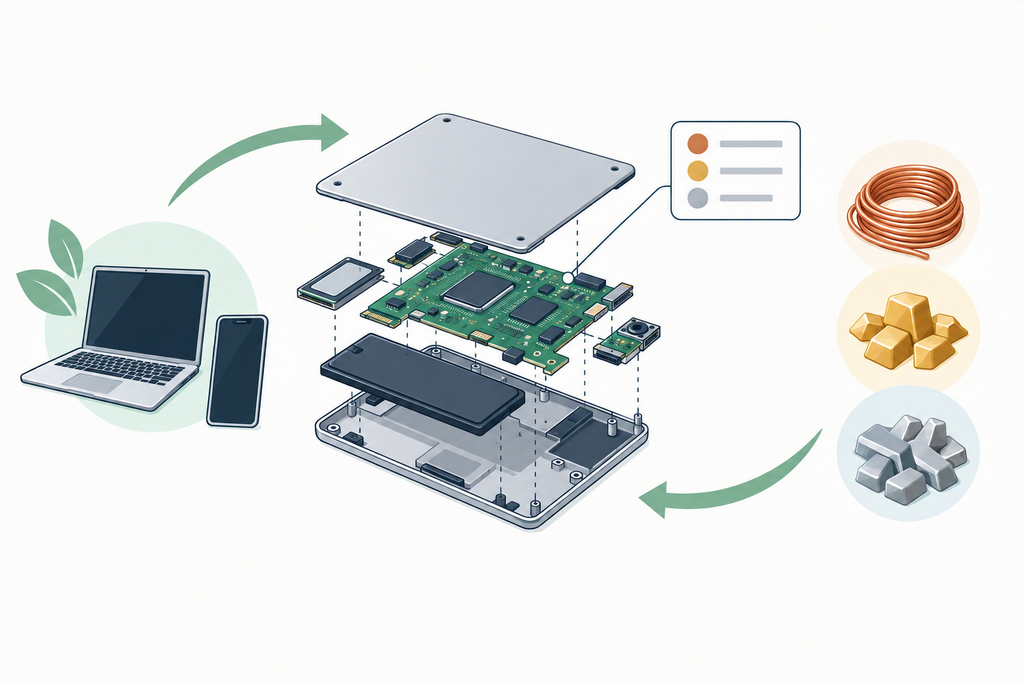
Imagine a system in which component manufacturers provide information about the valuable resources contained within their products, and that information remains associated with the finished product throughout its lifecycle.
For example, a product record could identify approximate quantities of gold, silver, copper, nickel, neodymium, and other valuable materials.
If such information were readily available, recycling companies could estimate the potential value of recovered materials before collecting or processing a device. This could support:
- More effective prioritization of recycling targets
- Selective recovery of high-value components
- Optimization of disassembly processes
- Better economic forecasting for recycling operations
Maybe similar concepts are already being discussed within the recycling industry. Or this might not make much sense to the experts. As an outsider, however, it seemed more logical to determine what valuable materials are contained in a product before shredding it than conducting elemental analysis to estimate their value after crushing the products.
Final Thoughts
This exhibition provided a valuable introduction to the current state of e-waste recycling. My primary takeaway was that the industry’s current foundation remains a combination of shredding, separation, and material refinement.
At the same time, viewing the industry from the perspective of electronic product design and manufacturing highlighted opportunities that extend beyond recycling facilities themselves. Improvements may also come from better product design practices and more effective information management.